
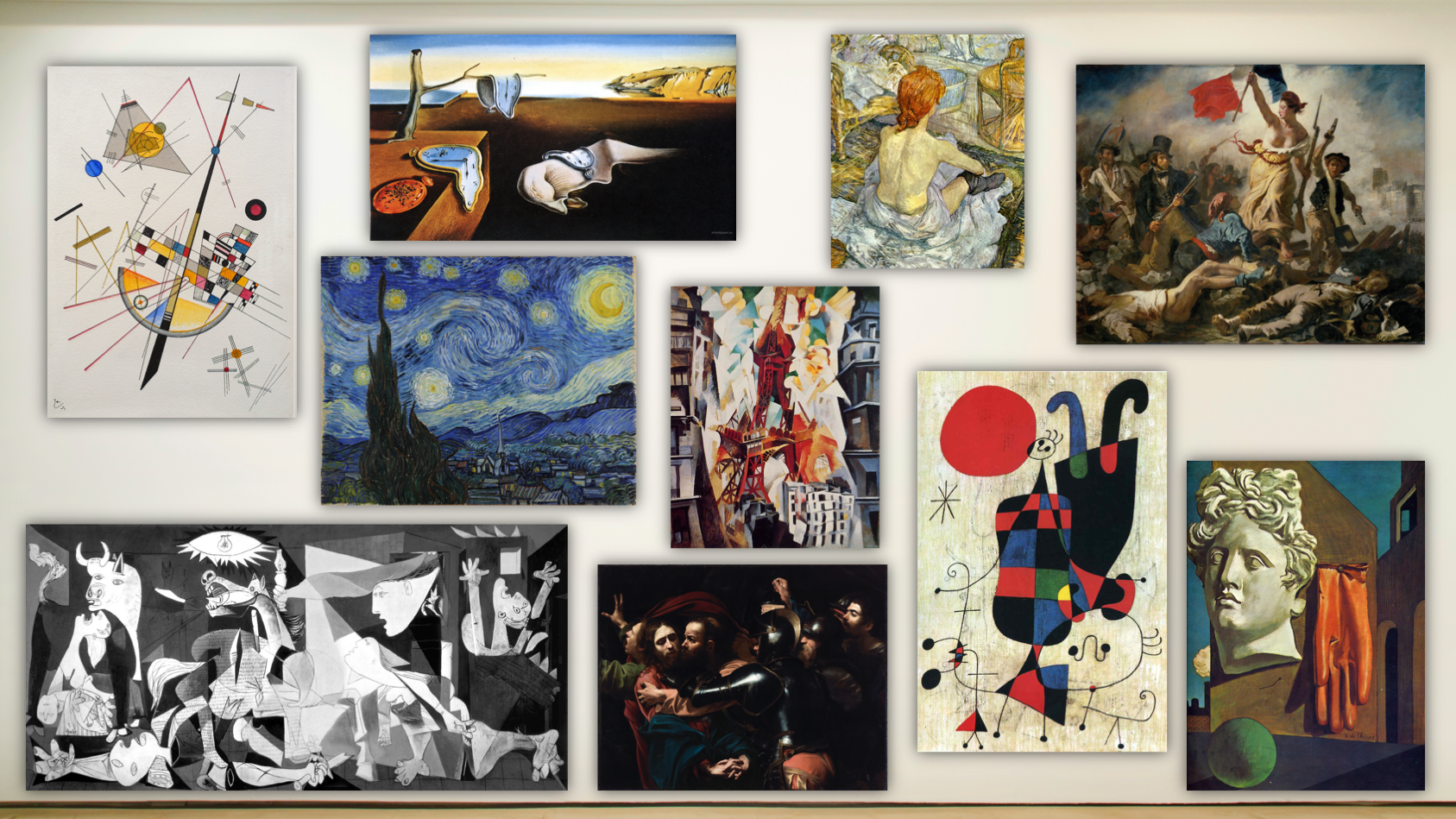
In order for someone to understand art, what they probably need is to find a way to “communicate” with its creator. Many times, different fine arts “join forces” so that they can reveal to a wide audience the power and the essence of each work. It is precisely this technique that I decided to use in my attempt to observe, in a more analytical way, a form of art about which I neither had, nor still have, any particular knowledge: painting.
The method, then, was simple: in order to be able to observe the detail of “classic” works from the world’s visual heritage, I decided to combine my approach with an art form that I know better: music. I believe the process helped me; I enjoyed it, and so I decided to share in this article some of these “marriages”, at least as I arbitrarily decided to create them. This small collection includes works by giants of Art, from both forms that are presented, and thus it easily invites any discussion about my choices.
As one can understand, then, this article does not aim to present the knowledge of an expert on art, or on the arts in general, but to make public a personal experience, which can be useful. Its usefulness lies in the fact that many times art is not easily digestible at first contact; it requires familiarity, and for that to happen one often needs to open a door that opens the path of communication with the artist. This particular experiment showed that the combination of two different forms can constitute both that key and that compass, in order for someone to be led to a second level of communication beyond that of the first observation.
-
Wassily Kandinsky, Zarte Spannung (Delicate Tension) – George Gershwin, Rhapsody in Blue
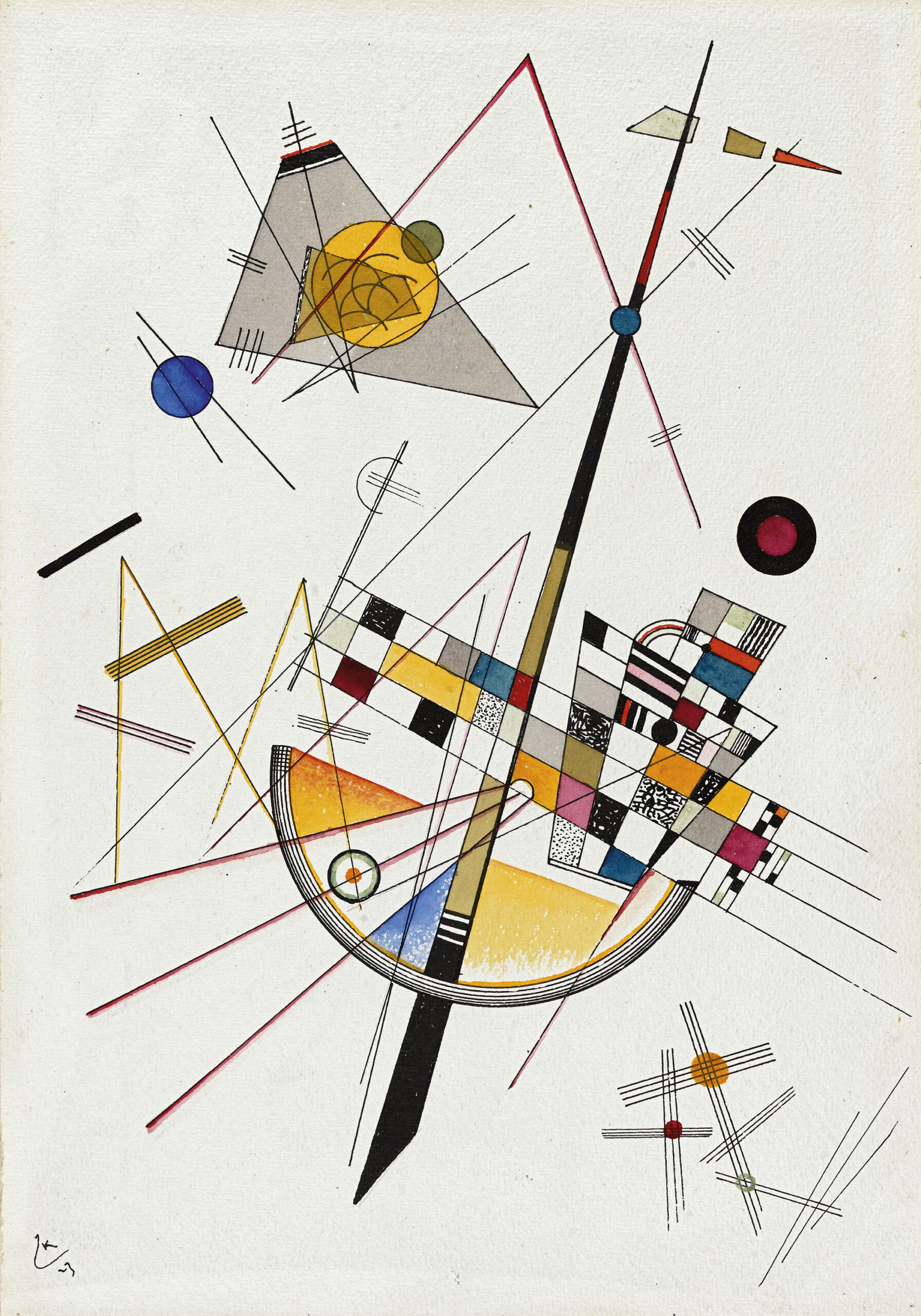 I will tell the truth: the spark for this whole process was this painting by Kandinsky. In one of my countless searches on the internet, one day I began observing his work and I literally “got stuck” on this piece. It is a painting that gives me mental rest; it gives me the possibility to get lost inside its complex perspective, while the simplicity of the watercolour background gives the sense that all this complex thought-construction is somehow suspended. I could say that the entire composition reminds me of something space-like, with stellar objects around it and countless functions upon it. However, the painting was created in 1923, long before the first space programmes, and I think that the creator had anything but that in mind.
I needed a piece of music to connect with this observation, a piece that would fit the “journey” my gaze makes into every corner of it. What came and “stuck” remarkably well was George Gershwin’s Rhapsody in Blue. The “Rhapsody” of the American composer is just as modern for the same era as Kandinsky’s painting, and perhaps that is an element that links the two works and creates, in my own senses, the feeling that a certain harmony exists between them. The work, initially written for piano and later including a symphonic orchestra (with the epic opening clarinet glissando), is a concerto in which there is a continuous conversation—through more intense and calmer phases, which, however, are not divided into movements—between the soloist and the orchestral ensemble. These phases can guide the gaze over the painting, from seemingly simpler parts, usually the “accompanying” outer ones, to the more complex ones, which lie mainly at the core of the central cluster. The melodic, slow orchestral passages add movement to all the two-dimensional elements of the paper, which seem ready to rotate around a clear central axis and thus, clockwise, to prepare their course towards a greater dimension, outside the luminous watercolour.
After this experience, I felt that I could see better every other great work of painting (perhaps you will feel it too), and so quite a few examples followed—some of which are the following!
-
Vincent van Gogh, La Nuit étoilée (The Starry Night) – Antonín Dvořák, Serenade for Strings in E major
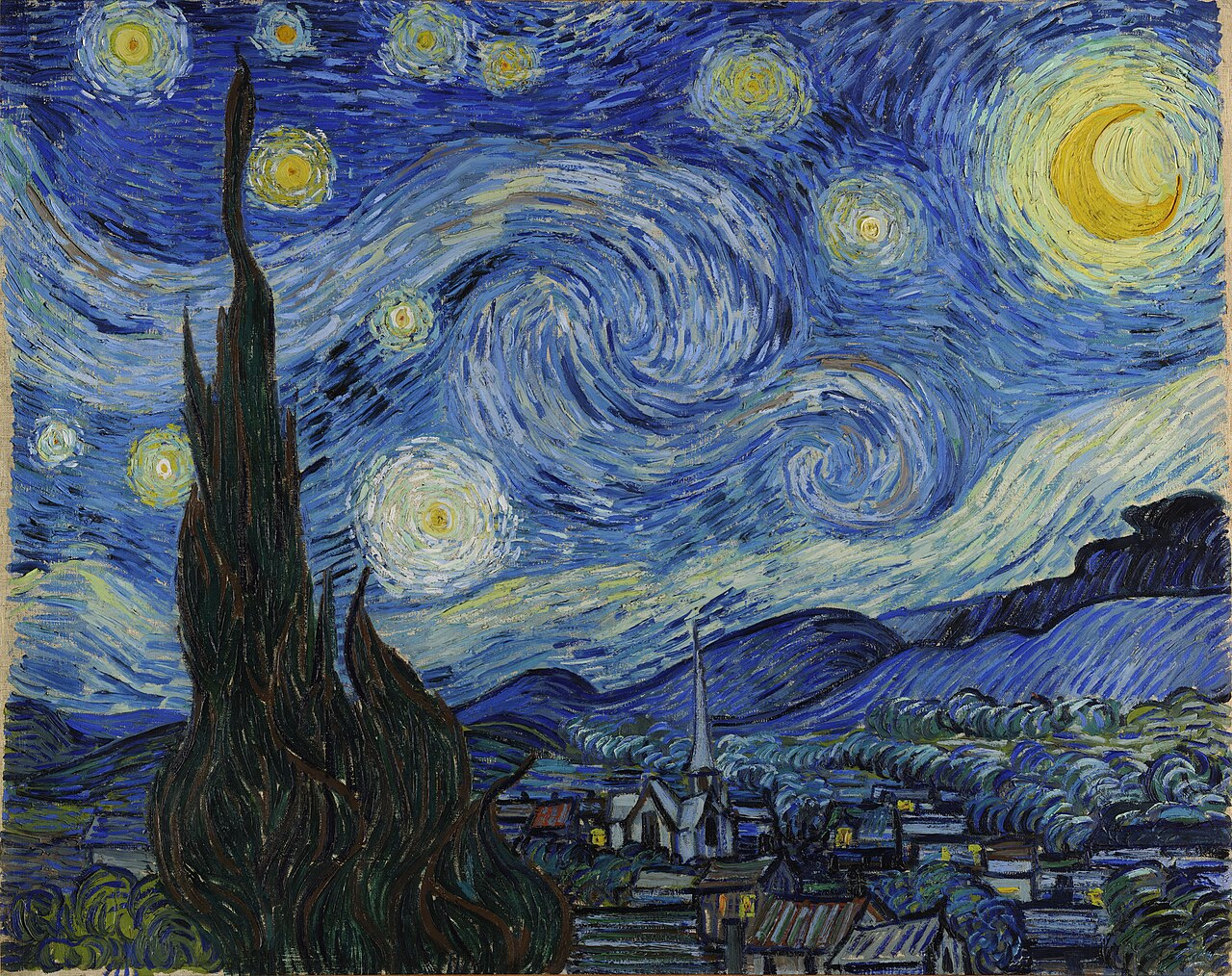 The painting obviously needs no particular introduction, since it is one of the most widely showcased works of painting in every corner of the planet. Its creator, too, is a peculiar pop star of sorts, a myth linked to his schizophrenic life. Thus, it is quite stereotypical to say that this is the painting that has impressed me more than any other, when I had the chance to see it up close. The truth is that encountering van Gogh’s paintings through book pages, posters, or digitally, and the sensation of observing them from very close, are two entirely different experiences—something that happens with most works in any art form—but I have the sense that in this case this difference is a little greater.
When I visited the MoMA in New York, where The Starry Night is exhibited, I had entered, anxious, for a few hours into the centre of the American metropolis, a few hours before my flight back to Europe. Entering the museum, I headed straight to the floor where this painting was, so as to start from there (from top to bottom for those who have been). Yet in front of its sight every sense of time stopped existing; nothing mattered. I don’t know how long I sat in front of this masterpiece, staring at van Gogh’s brushstroke, which is alive to this day in all his paintings, thinking that the artist is there at that very moment in front of you and creating. The intense capturing of the creator’s impression of the image he depicts—which also gives its name to the movement of impressionism—is clear to the greatest degree in this painting. It is very easy, from the room of a museum in New York, to suddenly feel that it is night; that you are stepping on the soil and the grass of the French countryside, in an era when human lights do not weaken the glow of the celestial bodies, and the dance of our galaxy is imprinted in what the human mind perceives as the heavenly dome.
This feeling needs its own music in the background to be complete. Although the work has its own “soundtrack”—Don McClean’s song “Vincent”, with the characteristic line “Starry starry night” repeated at the start of each verse—this melody does not belong to this scenery; it describes, in a larger time frame, the artist’s course. The sensation of observing the nocturnal starry sky, with the movement of its bodies and the presence of all the elements that stimulate the five senses in an outdoor night-time experience, is, in my opinion, captured by music written precisely for that time of day: a serenade! One of the best of its kind—rich in tender emotional elements in its second movement—is the one Dvořák wrote in 1875 for a string ensemble in E major.
The melody that feels most like gliding over an idyllic place, which will always be, for the human being, the sky, has the ability to depict those enchanting phenomena of nature that the painter saw fourteen years later, was moved by, and gave to us so that we might be moved and shiver through the centuries. The combination of these two works, in my opinion, makes every word seem insignificant before the power to create visible feelings, through the bodily effects they produce in their observer—something I very often attempt!
-
Joan Mirò, Personajes y Perro ante el Sol (Figures and Dog in Front of the Sun) – Arturo Márquez, Danzon No.2
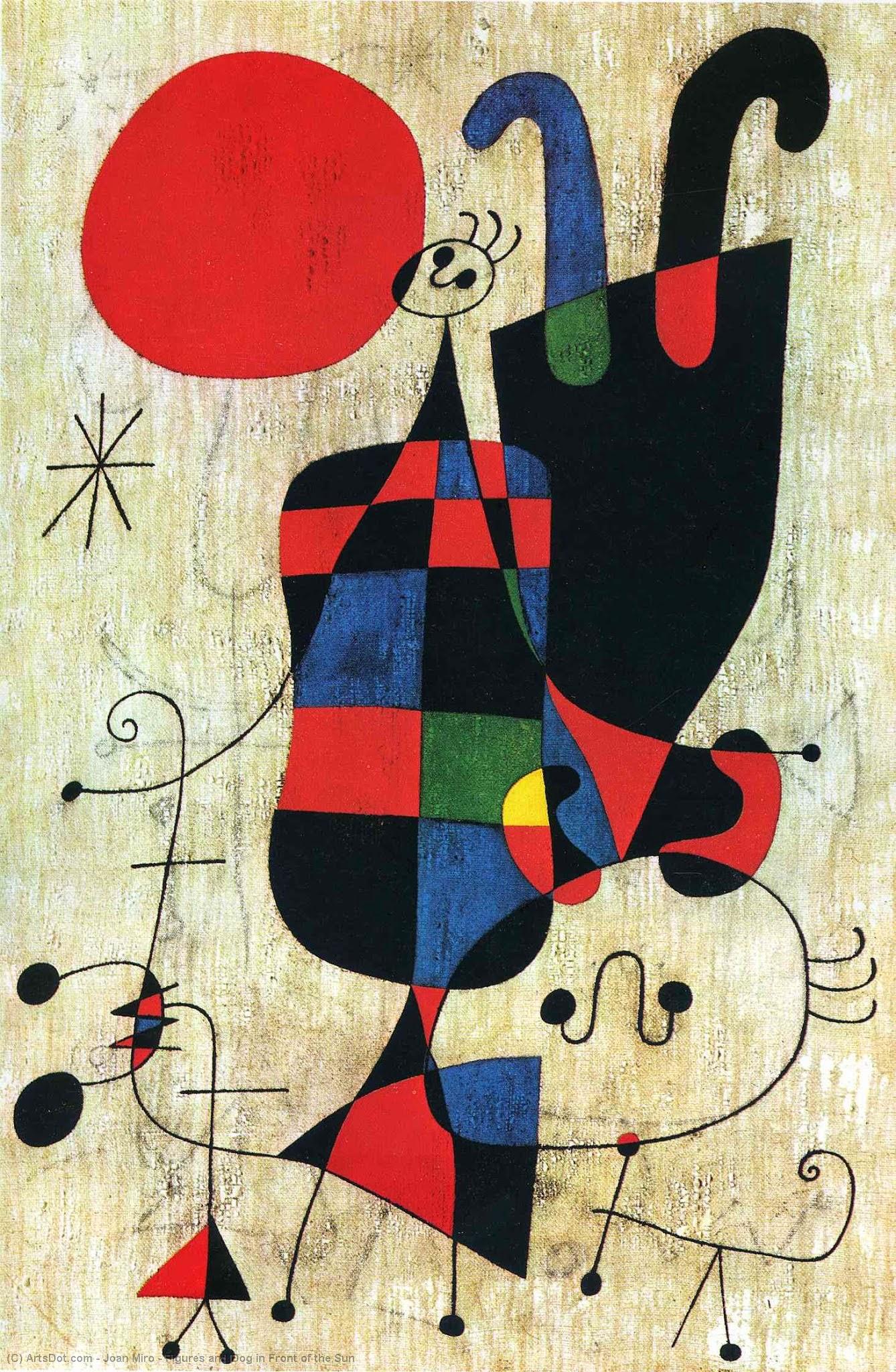 Mirò’s work is easy to misunderstand because of its “childlike” style: the “careless” curved lines, the intense abstraction, and also the intense—often even mismatched—colours that recall a child’s palette. This misunderstanding is even more dangerous if someone has a Mirò painting above their seasonal childhood bed, as happened to the writer with the specific painting presented in this paragraph. It is difficult to judge things connected to our childhood, because they already contain an intense dose of nostalgia and tenderness, which quite often is not the creator’s aim. However, a scene that shows two human figures and a dog under a dazzling sun—also because of its depicted size—is something that certainly creates a sense of psychological relief.
This particular Mirò painting plays with the strong colour contrasts of the Mediterranean summer, or any other place in the world where one might find oneself in a similar situation due to climatic conditions. The intense red of the sun gives the warmth the whole scene needs; it is not like the sun in other paintings, by other artists, from other geographical origins, where the colour of our star is much paler. The intense colour, which approaches reddish hues more in the last hours of the day, is what also creates the strongest shadows, the deepest shades, and often the most intense impressions. These shades and shadows appear on the Spanish painter’s drawing, even if they are arbitrarily entangled within the strange silhouettes that define the figures of the three living beings of the painting.
In order to combine the above elements with a melody from the global repertoire, it is difficult to associate the painting with a piece from classical Western European music. The climate in which it was created is expressed in its rhythm, in the scales it follows, in the intervals of its melody. It needs something correspondingly more “playful”, strictly in a major key, with sweet transitions and plenty of staccato either in the main melody or in its accompaniment. I found these elements in Danzon No. 2, and it is no coincidence that it is the work of a Mexican composer, Arturo Márquez—coming, that is, from a country where such images are not unfamiliar at all, neither in nature, nor among people, nor even among dogs!
The combination of this extraordinarily emotionally powerful music and Mirò’s technique, which makes anything feel familiar, creates a marvellous marriage—so easy to digest that perhaps anyone might feel they can recreate it from their own thoughts, if they don’t get confused thinking they have already done it!
-
Pablo Picasso, Guernica – Joaquín Rodrigo, Concierto de Aranjuez: 2. Adagio
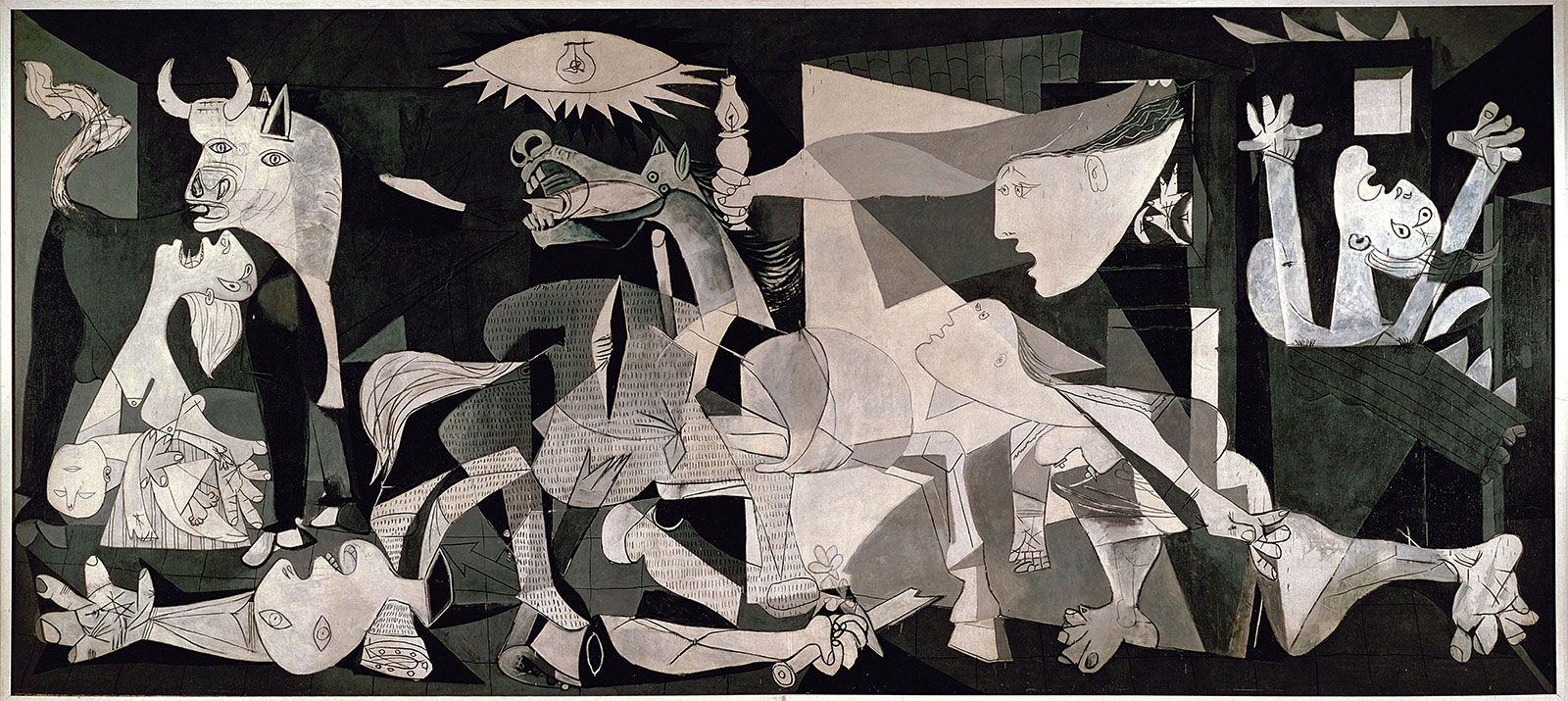 Pablo Picasso was a genius! I know that I am stating the obvious with this observation, but it is difficult to express thoughts after the speechlessness created by contact with one of the most emblematic works of art of the 20th century, explosively connected to one of its most important historical events. In April 1937, after an invitation by the Spanish nationalists, German and Italian fascist-Nazi aeroplanes fly over the Basque town of Guernica (or Gernika) and literally level it, committing one of the most atrocious criminal acts that marked the ideology of hatred and human history. A communist painter decided to leave his mark, so that this event would become a map in the universal human conscience, and he set his brushes in motion to answer the barbarity.
Picasso’s genius lies in how he managed it. The enormous dimensions of Guernica place the observer inside the scene itself, in the dystopia created by the absolute dominance of death on every side of the canvas, as happened on every side of the small Basque town. The scene is almost cinematic, with the intense moment—where the ultimate hubris against the human species takes place—passing torturously slowly before the viewer’s eyes; the viewer thinks they can, but feels even more powerless and even more miserable, understanding that they cannot stop it. This cinematic “slow motion” becomes even heavier within the literal immobility of a painting, which nonetheless contains such an intense entanglement between all its tragic living elements that you easily grasp that things are fixed at that very instant: you see it unfolding before you, yet you cannot stop it, and the atrocity overwhelms you.
In cinema, such scenes are usually accompanied by calm, slow music—unless, of course, it’s Hollywood, where all the brass on the planet plays so that the surround can be heard. The painting needs something corresponding: an utterly mournful minor melody, without a trace of hopeful mood, like a continuous weeping—a heart-rending weeping that follows the silent scream of the victims, that accompanies the conscience of the irreversible character of destruction. This music, in an absolutely Spanish style, is Rodrigo’s Concierto de Aranjuez, where the guitar becomes the narrator of the most sorrowful story.
Rodrigo wrote the concerto two years later and linked it to a medieval story of kings, because only in that way would the victors of the civil war—the fascist state of the Francoists—have no problem with it. Yet, for some reason, in the collective consciousness of the Spaniards, it has remained as a hymn to the atrocity of Guernica, and I consider it no coincidence that, without knowing this (before looking it up), it subconsciously created the same impression in me as well, fitting Picasso’s painting like a glove. The pairing of these two, in my opinion, is not simply instructive with regard to art, but also with regard to world history—the ideological conscience that is shaped in every part of the planet, not in a moment, but over the passing of years.
-
Giorgio de Chirico, The Song of Love – Manos Hatzidakis, Gioconda’s Smile: Portrait of My Mother
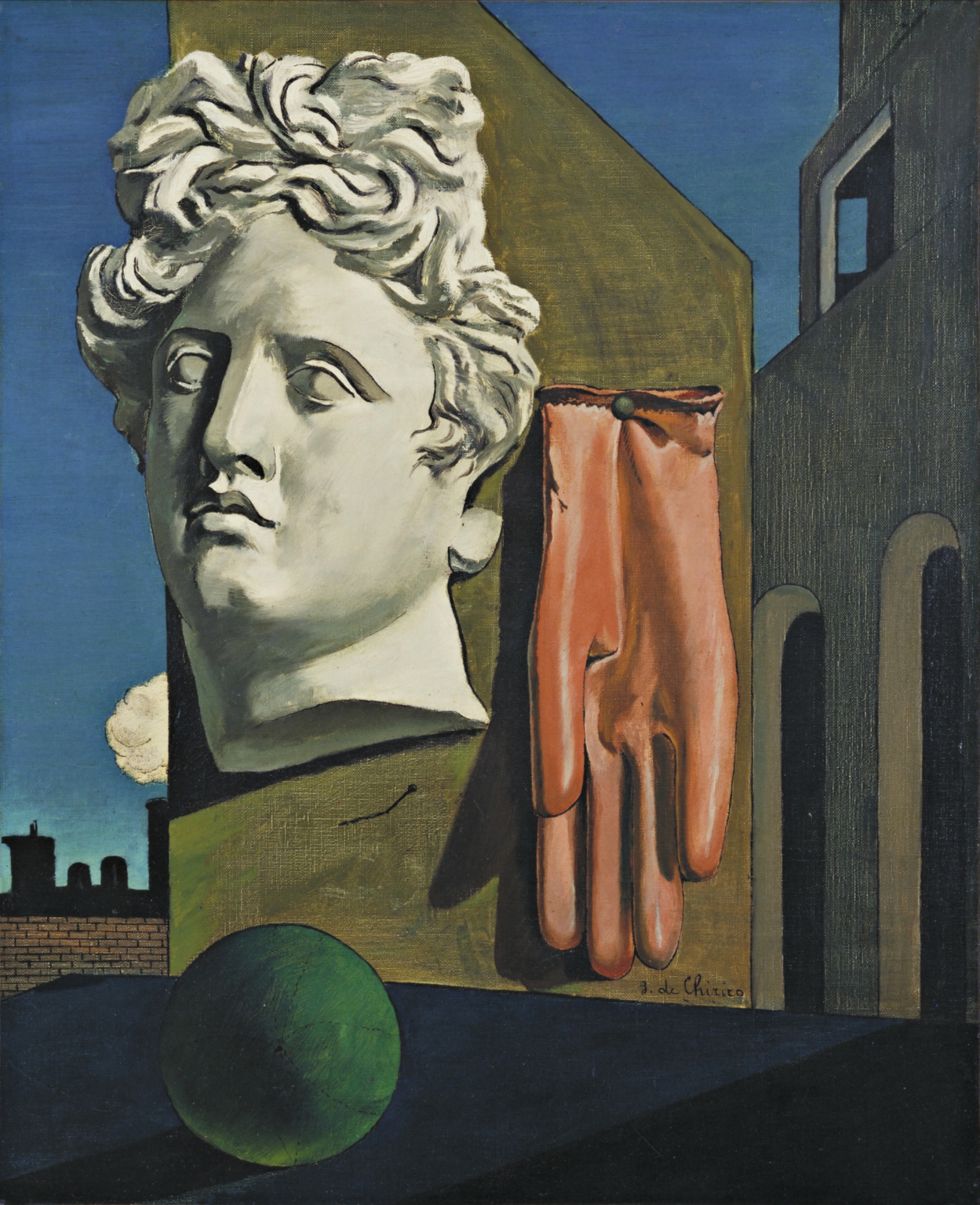 De Chirico’s painting is exactly what its name says, and perhaps something more—not simply a song, but a hymn to love. Personally, for some reason, the love depicted in this painting is not romantic love, but one of the strongest feelings that follows a human being from the moment of birth and throughout the course of their journey in life: love for one’s mother. There is no figure that symbolises absolute devotion and inexhaustible giving more than what parents symbolise, with the mother having the “privilege” of the tender embrace—either when it comes to place you in its warmth, or when the need arises to hold her within your own arms, protecting the protection she gives you. The presence of the nailed glove on the wall outlines— even if a rationalist might consider it stereotypical—the presence of this maternal figure.
For someone who has grown up in the Greek world, and thus the maternal figure is connected also to the past before their own life, the symbolism of the classic ancient Greek statue can tie perfectly with the ordinary everyday object nailed beside it, while the ball, a symbol of childhood, is placed in front of them on the ground that the observer defines—not on the wall made for displaying what others have made for him. De Chirico took care to place all this under the shelter of a deep blue summer Mediterranean sky, with the presence of the sun dominating the shadows of the objects and the absence of doors and windows in the surrounding constructions creating a sense of heat that emanates both from the scene and from the feelings it creates. Personally, the fact that de Chirico’s birthplace is the same as my mother’s made me connect all of the above even more, to the point of thinking that the painting was made for her.
Such a Mediterranean scene also needs the corresponding Mediterranean music for one to absorb it. The best example of such orchestral music—more than anything else evoking these scenes—was created by Manos Hatzidakis, who, even though he named it “Gioconda’s Smile”, certainly connects with images far more familiar to us than da Vinci’s pale enigmatic work. The piece “Portrait of My Mother” thus seemed as if it came to attach itself to this painting, to such a degree that I personally thought, “he couldn’t have been thinking of anything else” when he wrote it, with the coincidences being too many when one realises that the work is exhibited in New York—the same city where Manos wrote his greatest musical work.
-
Michelangelo Merisi da Caravaggio, Presa di Cristo nell’orto (The Taking of Christ) – Antonio Vivaldi, The Four Seasons: Summer, III: Presto
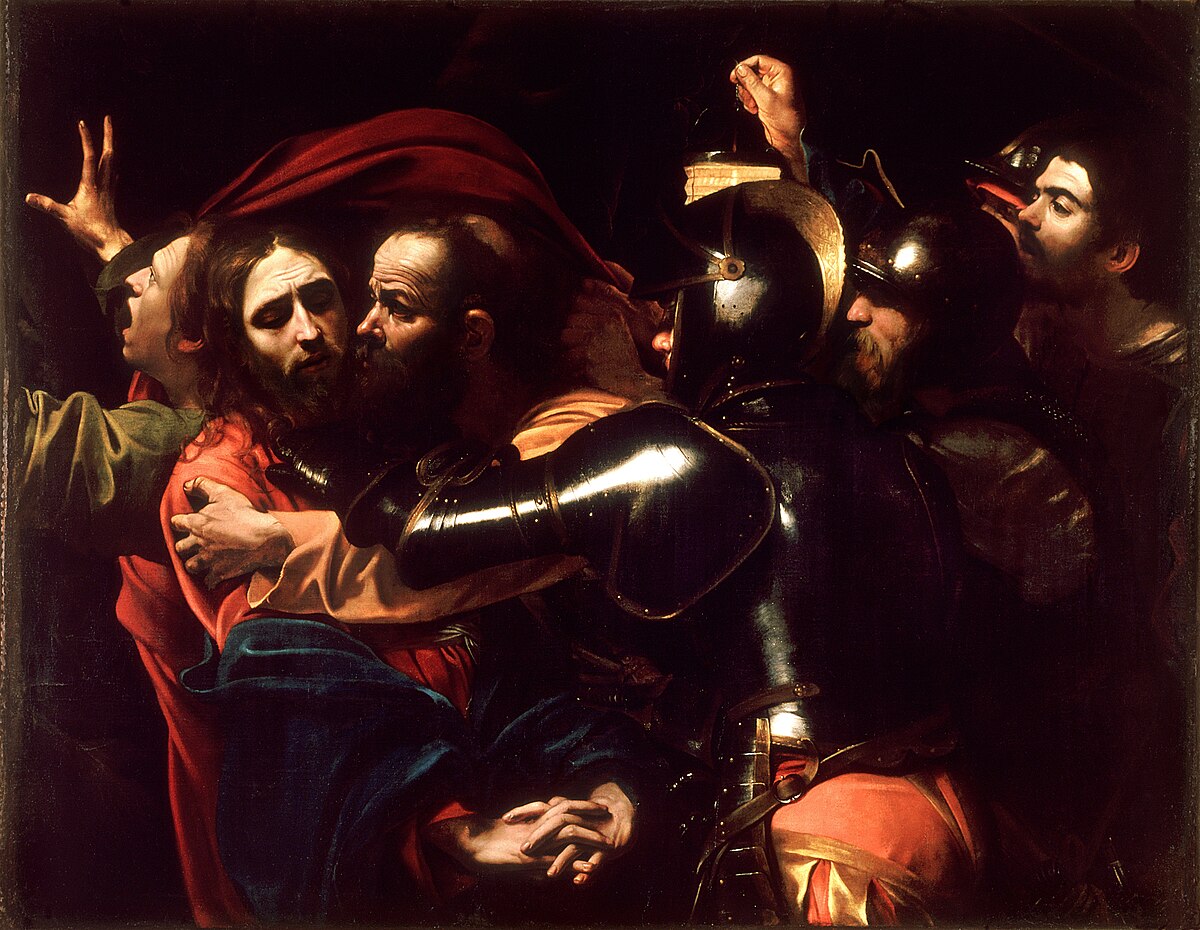 Caravaggio is one of the most characteristic representatives of the Italian pictorial Middle Ages. The perfection that a “God-inspired” work must approach, in order for there to be the corresponding reverence toward religious subjects, as well as the light that comes from an undefined place to illuminate only the faces of the protagonists of each scene, hiding anything that is not necessary for the narration—these are the basic characteristics of each of his paintings. My personal contact with his paintings was perhaps one of the first I had with works by artists of the world firmament, and that matters both for the inspiration to include him in this list and for the way I connected, even from then, his paintings with a particular musical school.
This contact happened in 1997, when, within the framework of “European Capital of Culture”, one of the three most important events that took place in Thessaloniki was hosting the exhibition of Caravaggio’s works at the Government House (also known as Palataki, even before it reached the tragic state it is in today). It is a fact that as I grew up I observed that the works—in any art—that I consider the greatest were created closer to my own era, hoping that before I complete my journey in this world I will have arrived at the enjoyment of the “today”. However, then, Caravaggio’s paintings seemed unsurpassable and supreme, with the main element that impressed me being the perfection and fidelity of the depiction of human figures—so much so that you often think they are photographs.
At the same time, also because of the conservatory, the music I was coming into contact with was Baroque, and the composer I considered supreme was Vivaldi, with the objectively easy-to-marvel-at creation of The Four Seasons. I think that is also why, in this particular painting—which narrates a very specific and well-known religious scene—one of the best-known parts of The Four Seasons fit me perfectly: the famous “Storm”, or the third movement of “Summer”. The almost anxious presence of continuous small musical fragments also captures the panic of that moment, when, in a crowd, with the presence of Roman soldiers and all of Christ’s disciples, Judas lunges forward to give the kiss that defined the greatest religious crime: the betrayal of God by man himself—something that, if we did not suffer from centuries of ecclesiastical oppression, could be a subject for magnificent theatrical tragedies. The music sketches the feelings of all the characters, who are in hyper-stimulation up to panic, except, of course, the God-Man himself, who must be in a characteristic calmness and can draw our attention only at the points where the fragments become larger (that is, the notes last longer).
The painting—and Caravaggio’s work overall—is perhaps the most Baroque thing I have encountered in my contact with painting, and I could not have faced him with the work of any other composer, except that of his compatriot, Vivaldi.
-
Salvador Dalí, The Persistence of Memory – Edward Elgar, Cello Concerto in E minor
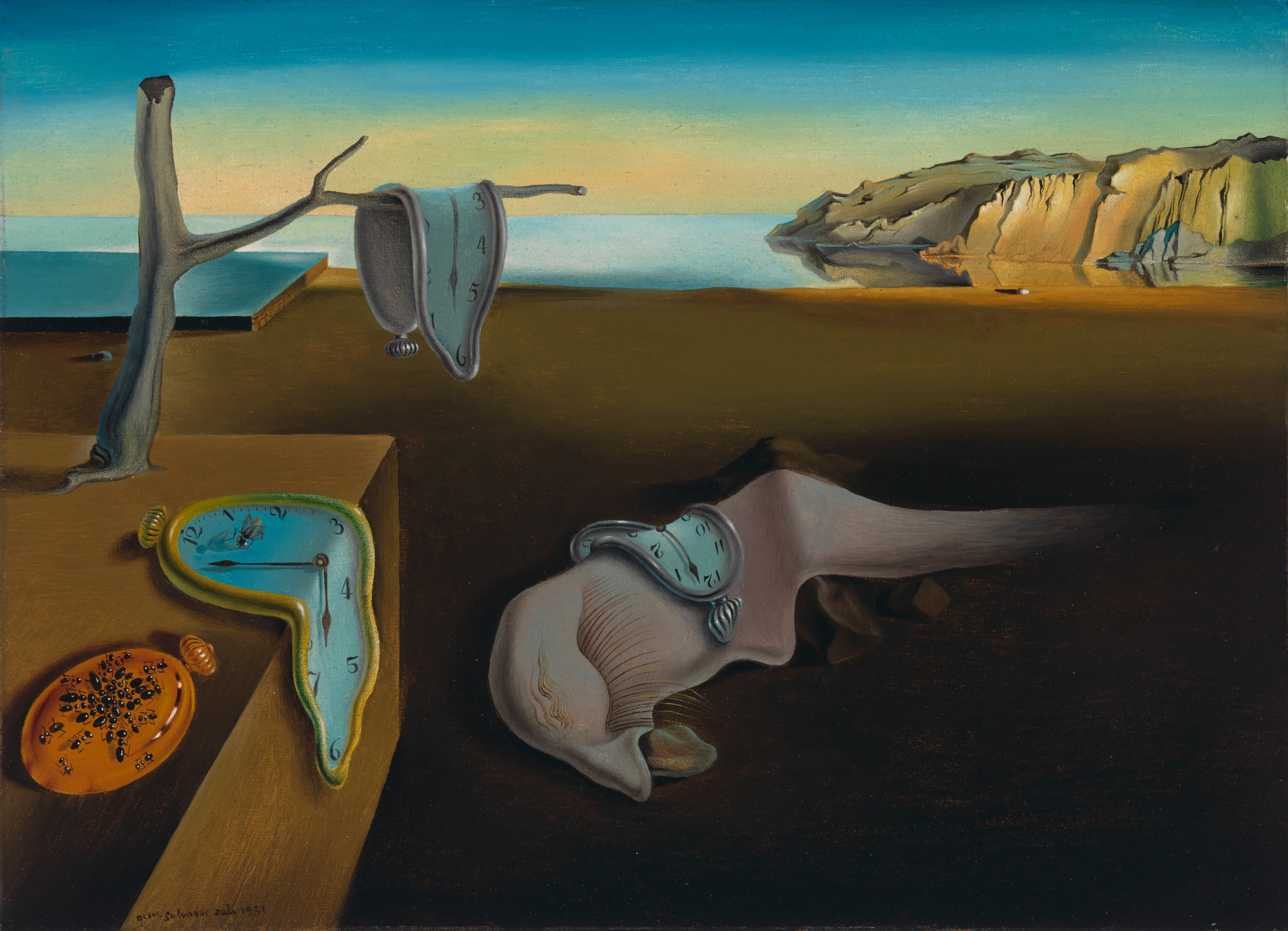 Dalí is a dreamlike painter. What he put on his canvas, while corresponding to real objects from real life—or at least to very distinct figures—you cannot easily understand why they are placed there, and why they are, in a specific way, different from the real world. The first contact can look simply like an experiment, a play with the states of matter; however, the behaviour of living or inanimate objects, even emotional grimaces, are the elements the painter gives you in order to wander through his thinking, which, in the end, is anything but abstract. Perhaps his most emblematic painting is The Persistence of Memory, which many recognise from the “melted clocks”.
In a relatively empty and deliberately completely lifeless landscape, with the only living presence being small insects—usually connected with decay—time bends over anything dead, whether it is a tree or an imaginary figure of a human face. Attempting an abstraction, guided also by the title, one could say that time, considered all-conquering, cannot withstand competition with memory; it bends before the presence of the dead, which it subjugated but failed to erase. For someone who analyses life and death in depth—and Dalí was probably one of those—this is an optimistic scenario, given, of course, with an extraordinary cynicism that characterises his work as a whole.
On this theme I had a personal experience, in which one of the classic works of 20th-century music is also woven. Listening to Elgar’s Cello Concerto—considered the greatest work for cello by specialists and non-specialists alike—a story formed in my mind that could be the theme of a novel or the script of a film. The story has a couple living and enjoying life until the moment one of the two leaves the world, scattering grief over their partner. The one who remains behind, however, does not accept fate and places themselves in a psychological state of prolonged, conscious, deliberate denial, attempting to continue their life in exactly the same way as it happened when their loved one was present. They live in a madness, for example ordering for two at a restaurant, leaving an empty space beside them on the bench where they watch the world go by or a sunset, sharing every moment with a presence that is no longer near them. The title I had thought for this story—which obviously would not have a happy end, because a story like that cannot have a happy end—was Dueto Solo, in the sense that the protagonist was playing solo a work written for two.
Searching to see whether anything existed with a similar title, since it did not seem so original to me, I came across a film from 1986, Duet for One. The astonishing coincidence was that the film narrates the tragic life of Jacqueline du Pré, who to this day is considered to have given the greatest and unsurpassed interpretation of Elgar’s Concerto, and who died of multiple sclerosis in 1987. This strange “circle” of events bound this piece inseparably to the above story—and this story connects perfectly with the “Persistence of Memory” that Dalí presents in his painting. What else could fit these two works better? The only question is which of the two was made to accompany the other…
-
Henri de Toulouse-Lautrec, Femme à sa toilette – Georges Bizet, Carmen Suite No.2: 2. Habanera
 Toulouse-Lautrec placed on his paintings one of the periods in which leaps occurred in sexual emancipation. Non-partnered erotic stimulation was decriminalised in 19th-century France, with the result that deep erotic feelings could also enter a different, cleaner and freer basis, where their enemy was now the self, and not the various social models and prejudices of the era. The same people, however, who participated in the one process—the orgiastic and superficial one—usually also had the deepest passions that characterise pure emotions. This contrast is hard to understand even in our time, because of residues passed from generation to generation, and also because of a peculiar puritanism that appears under particular economic conditions.
The painting “Woman at Her Toilet” (with “toilet” having a suggestive meaning—the space in her apartment but also her dress; translations in fact vary) shows exactly that. The woman seated on the floor, clumsily on her dress, with a gaze that resembles more the absent gaze of someone thinking, without proceeding with her dressing or undressing, is the embodiment of the contrast produced by this emancipation. She is a young dancer, with beautiful proportions, whose role is to seduce the crowd—and because of her natural gifts we may assume she achieves it easily—who nonetheless has worries in her own life, a worm that forces her to sit on the floor, place her hands on her legs, and, staring vaguely ahead, surrender to what she herself feels. Toulouse-Lautrec takes such a woman and, from “common”, raises her many levels, bringing her to a more modern condition where—no longer being the property of father and husband—she is troubled by her own passions and feelings, even seeming confused within them.
Around the same era, a tragic heroine—independent, mythically captivating, both perpetrator and victim of her feelings—enters the universal artistic heritage. The Spanish Carmen becomes opera, and Bizet, through her passions, expresses his own complaint about his “proper” and “well-trodden” emotional life. Her emblematic Habanera is, in my opinion, the most characteristic foreshadowing of the drama that follows, and for that reason it is not a light song (I have argued about the character of the Habanera—I’m not kidding). How could the lyric say it better? “Love is a rebellious bird, it has never, never known the Law; if you don’t love me, I love you, and if I love you, watch out!”
The drama, the words and Carmen’s thinking can very easily enter the mind of the red-haired dancer—and the rhythm of her dance could perfectly follow that of a Habanera. Perpetrator and victim together, temporarily weak as she confronts herself, in the next performance she could well play Carmen herself.
-
Robert Delaunay, Champs de Mars: La Tour Rouge (Champs de Mars: The Red Tower) – Pyotr Ilyich Tchaikovsky, Piano Concerto No. 1 in B-Flat Minor
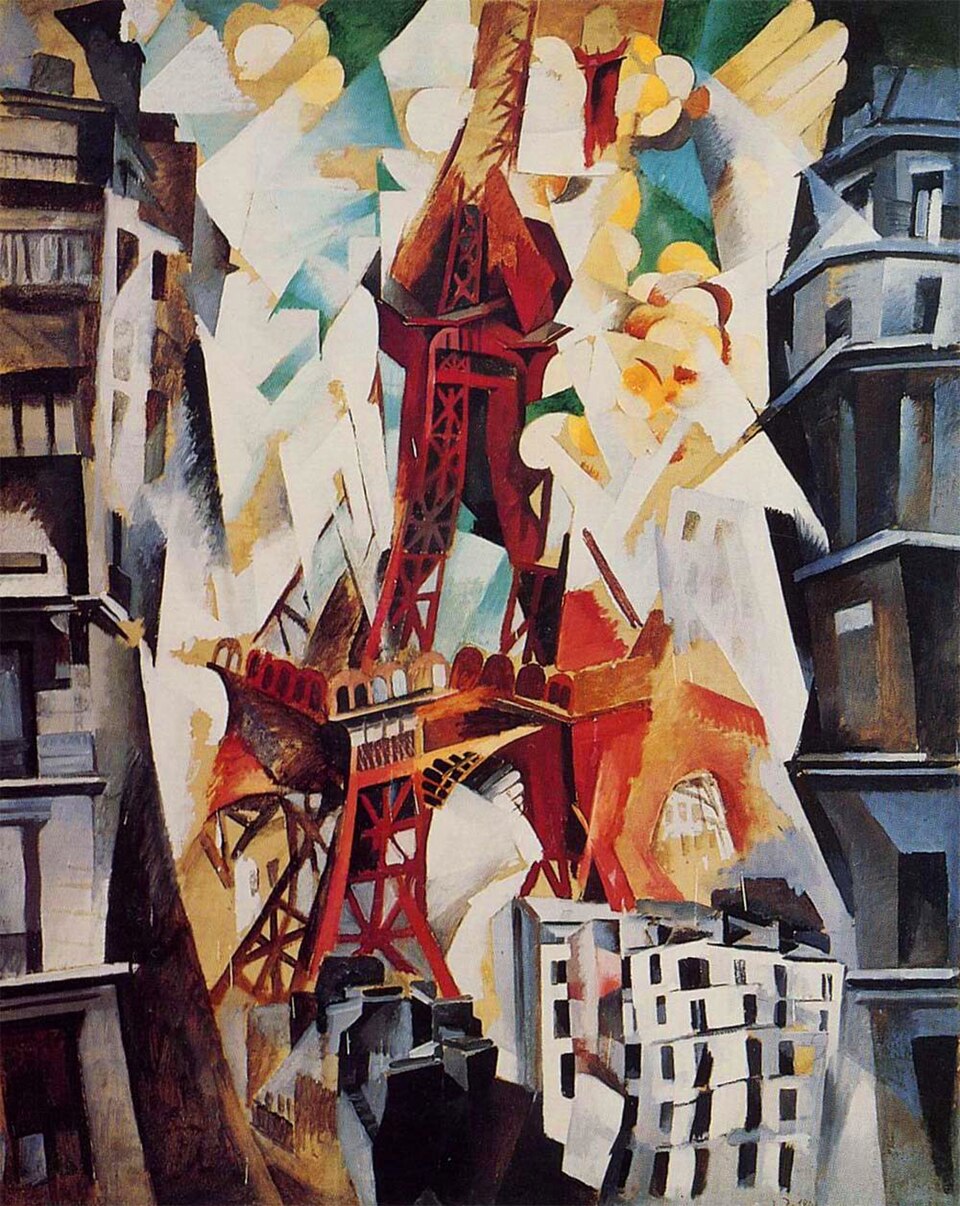 Delaunay is quite a distinctive painter, as he was the core of a small group that created a short-lived movement in Paris, which the poet Guillaume Apollinaire named Orphism (from Orpheus) and which is considered part of Cubism. In a series of his paintings he dealt with depicting one of humanity’s most emblematic monuments—a symbol of an era, of a passage to a next stage of material and technical development: the Eiffel Tower. The Tower, which many considered and still consider even today to be an ugly iron construction, is, in my opinion, one of the most tasteful human creations, giving character to an entire city and marking its contribution to the world.
In this particular painting, called “Champs de Mars: The Red Tower”, Delaunay has given an image of the Tower as it appears from many parts of the French capital, emerging at the end of streets, between buildings. The buildings create the outline, always in an abstract manner and, of course, with simple geometric shapes, while the brighter background with fragments of green and curves is the vast Champ de Mars at whose edge the creation of Gustave Eiffel stands dominant.
This image needs its own music, and the truth is that in the era of the Tower’s construction, French music was passing through an intensely romantic phase, expressing other things that characterised Parisian society at the end of the 19th century, and not the exceptionally revolutionary and innovative engineering, nor the revolutionary leaps of science in French institutes. However, this new element exists in the music of the time—even if it comes from another country, which then—in contrast to today—maintained excellent relations with France, gifting the City of Light one of its most beautiful sights as well: the Alexander III Bridge.
The country is, of course, Russia—where today there are clever neo-French who still question even the “Europeanness” of its civilisation. Someone with elementary knowledge, however, does not doubt for a moment where this complex comes from—something that in no way characterises France’s contribution to world culture. And yet, if there is a representative of Russian culture who leaves no doubt whatsoever about its Europeanness, that is Tchaikovsky!
Tchaikovsky’s Piano Concerto No. 1, if it is not the greatest, is one of his greatest works, and in my humble opinion it is the greatest piano concerto ever written to this day. This work fits exceptionally well with the image—or rather the set of images—that Delaunay presents in his painting. The “modern Paris” of a golden age, a hundred years after the French Revolution, casting its light over the whole world, is a mythical city—just as mythical as Tchaikovsky’s music—without any exaggeration in its romanticism, with everything being supreme, real, tangible, and accessible to the one who is within the space where everything happens, becoming at the same time a participant and, if they manage it, a creator or shaper of it. Paris of that era gave the Eiffel Tower, created the foundations for the artistic leaps expressed by Delaunay, and changed the world in such a way that Tchaikovsky wrote his astonishing work! All together, in one composition, they give us a strong scent of that ferment, and the twenty minutes of the first movement of the Concerto are enough to make us want to travel in time.
-
Eugène Delacroix, La Liberté guidant le peuple (Liberty Leading the People) – Ludwig van Beethoven, Symphony No: 9 in D Minor, “Choral”: IV. Presto
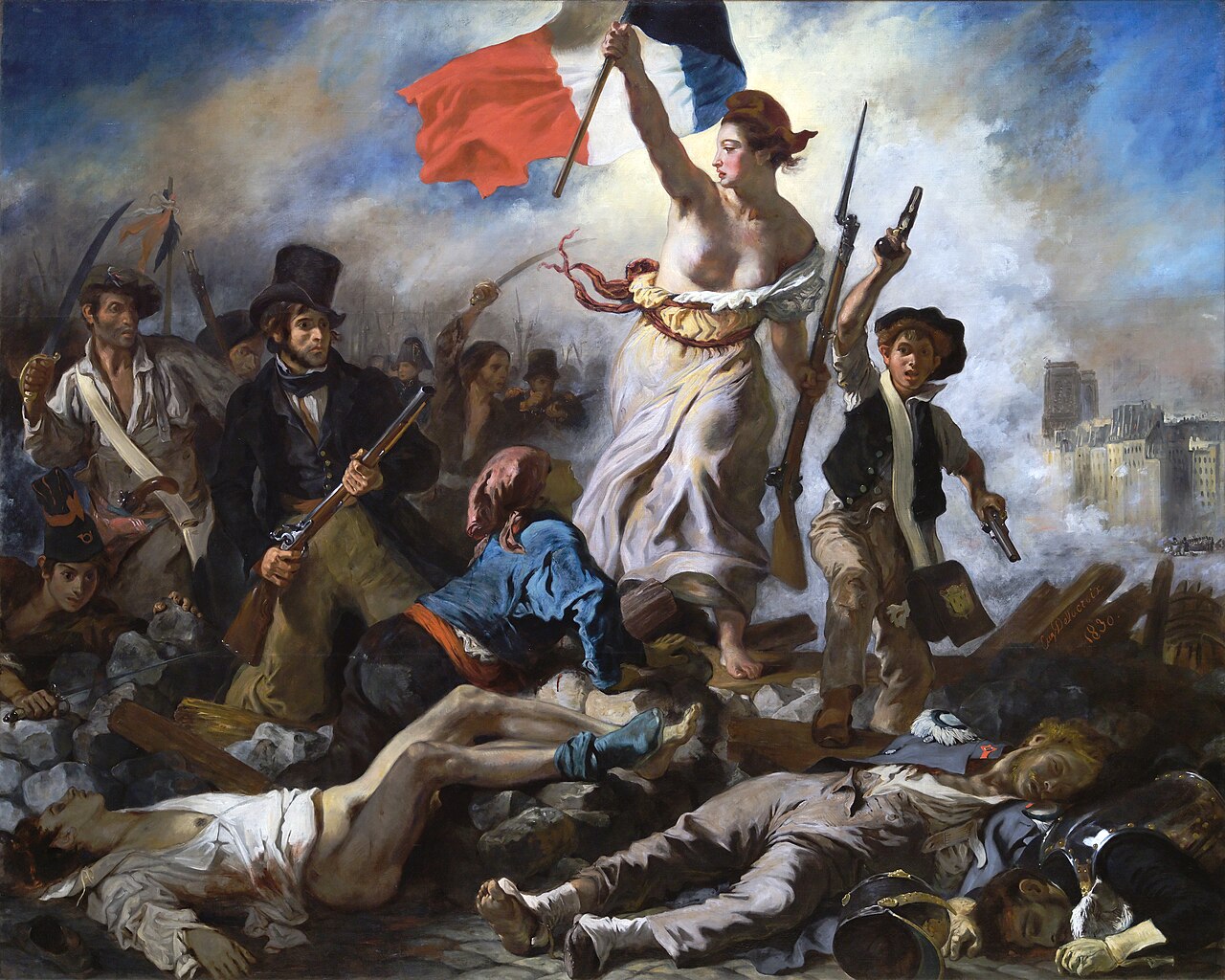 For the end, I left a supreme moment in human history. One of the events that marked not only history, but the evolution of the human being as a species—the process of its thought and the way its social relations on Earth were shaped—was the French Revolution. For those who do not know, the French Revolution was not a process that happened in one year, 1789; it happened again and again for about a century, up to the Paris Commune of 1871. The one who perhaps succeeded better than anyone else in describing this eternal process within the limits of a canvas was Delacroix, who in 1830 created the painting “Liberty Leading the People” to hymn the July Revolution of the same year, for which the corresponding monument also exists at the Bastille.
The painting is more than epic. Liberty dominates, in the form of a woman, to whom the ever-romantic French not only gave a name, Marianne, but made her the symbol of their Republic. Behind her, standing, the armed people; and beneath her feet, in the rubble, the people who gave their lives so that she might stand upon their bodies, waving the tricolour flag—symbol of the democratic coexistence of different classes within one society, the quintessence, that is, of bourgeois-democratic revolutions. Although specific symbolic figures stand out—bourgeois, peasants, workers, and, of course, a child holding two weapons—as well as the figure of the one who emerges from the corpses, seeing hope in her face, Liberty holds a weapon like many others we see lost in the dust of the painting’s depth. The scene resembles characteristic scenes from the area around Paris City Hall, the Hôtel de Ville, and Delacroix makes this clear by placing Notre-Dame of Paris with a similar perspective to that by which the historic monument appears from that point.
This majestic scene of human history could be linked with the greatest musical work that our species has managed to create to this day. On the identification of the latter, very many people far more expert than me have expressed themselves, and my own thought agrees with them, without any doubt whatsoever. Beethoven’s 9th Symphony is the best that has existed as musical creation across the centuries; and its final choral part, known as the “Ode to Joy”, however overplayed it may be, however it may have been used by anyone in ways that are an insult to its use, is an absolute eulogy to one of the most difficult feelings to describe: the joy of achievable hope—not of one person, not even of one people, but of the peoples of the whole Earth—symbolised in this painting, heard through Beethoven’s melody, who conversed with the “daughter of Elysium” and was told her secrets.
Instead of an epilogue…
The process of writing this article was not a simple affair. The experiment described, after the decision to share it, ended up being only the basis on which the thoughts that are, in brief, captured in the few paragraphs concerning each pairing were developed. The process of capturing, with specific words rather than in general and abstract terms, what I perceive from each work was something that helped me understand even better—not necessarily what its creator wants to say, but what I can draw from it based on my own experiences. For this reason, if in the introduction I explain that the reason for making it public is for others to try it as well, in order to come into contact with these art forms in a corresponding way, at the end I can say that if one takes a step further, trying to express one’s thought about these things, one feels that one has also drawn out a piece of oneself—and that, perhaps, is the quintessence of artistic communication: beyond the creator being able to express themselves through the work, the listener-observer—what is called the audience—also manages to express themselves. This is the power of great, timeless art!
